Traffic congestion in London has long been a defining feature of the city’s daily rhythm. From early morning rush hours to late evening gridlocks, the slow crawl of vehicles has become an almost accepted inconvenience. Yet beneath the honking horns and endless queues lies a pressing question: is there a more efficient, sustainable way to move through one of the world’s busiest cities? Increasingly, the answer points toward cycling not as a fringe alternative, but as a central solution.
The Anatomy of Congestion in a Growing City
London’s congestion is not merely the result of too many cars it is the outcome of a complex urban ecosystem. Population growth, economic activity, and spatial constraints all contribute to the strain on roads. Despite a well developed public transport system overseen by Transport for London, the sheer volume of daily journeys continues to overwhelm available infrastructure. Cars, while convenient, occupy a disproportionate amount of road space relative to the number of people they carry. A single vehicle often transports just one person, yet demands a significant share of limited urban real estate. Multiply this inefficiency across millions of daily trips, and congestion becomes inevitable. Cycling introduces a fundamentally different equation. Bicycles require far less space, both in motion and at rest, and they allow for a more fluid use of urban streets. In a city where space is at a premium, this efficiency becomes a powerful advantage.
Reimagining Urban Mobility Through Cycling
Cycling offers a reimagining of how movement can occur within a dense metropolis. Unlike cars, which are constrained by traffic signals, bottlenecks, and parking limitations, bicycles can navigate the city with a degree of agility that transforms the commuting experience. In recent years, London has made significant strides in developing its cycling infrastructure. The expansion of the Cycle Superhighways reflects a growing recognition that dedicated space for cyclists is essential. These routes, designed to provide safer and more direct journeys, have already encouraged thousands of commuters to switch from cars to bicycles. The effect is subtle yet profound. Each individual who chooses to cycle instead of drive removes a vehicle from the road. Over time, this collective shift has the potential to ease congestion in a way that road expansions and traffic management systems alone cannot achieve.
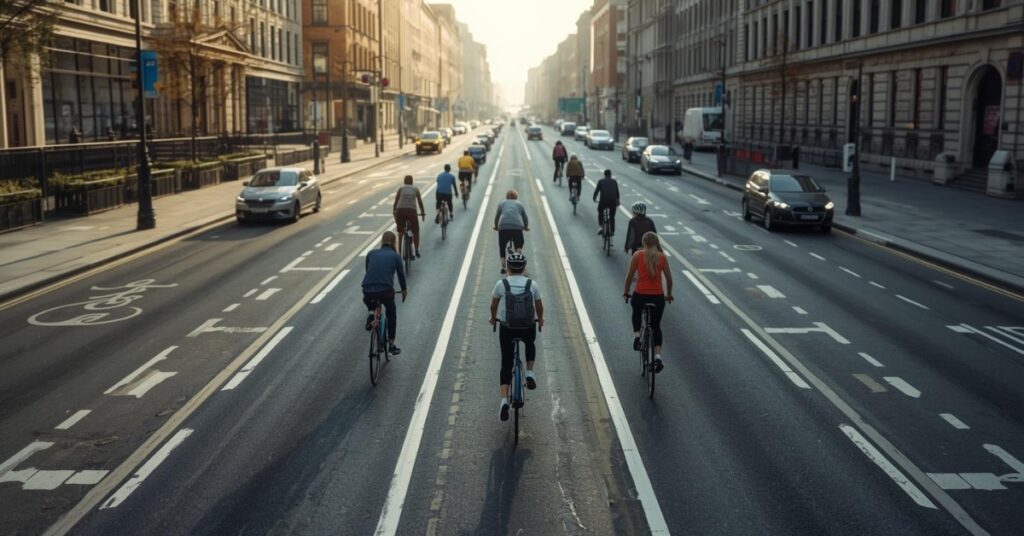
Efficiency in Motion: Time, Space, and Energy
One of the most compelling arguments for cycling lies in its efficiency. In heavily congested areas, bicycles often outperform cars in terms of travel time. While vehicles inch forward in traffic, cyclists can maintain a steady pace, bypassing delays and reaching their destinations more reliably. This efficiency extends beyond time. The spatial footprint of cycling is remarkably small. A single lane can accommodate far more bicycles than cars, and parking a bike requires only a fraction of the space needed for a vehicle. In a city like London, where parking is both scarce and expensive, this advantage cannot be overstated. Energy efficiency further strengthens the case. Cycling requires no fuel, produces no emissions, and relies solely on human effort. In an era increasingly defined by environmental concerns, this simplicity becomes a powerful asset.
Changing Mindsets and Urban Culture
Despite its advantages, cycling’s role in alleviating congestion depends on more than infrastructure; it requires a shift in mindset. For many Londoners, cars have long been associated with convenience and status, while cycling has been viewed as either recreational or niche. This perception is gradually changing. The visibility of cyclists on London’s streets has increased, and initiatives such as Santander Cycles have made cycling more accessible to a broader population. What was once considered an alternative is now becoming a mainstream choice. Cultural transformation, however, is not instantaneous. It unfolds through everyday experiences through individuals discovering that cycling can be faster, cheaper, and even more enjoyable than driving. As these experiences accumulate, they begin to reshape collective attitudes toward urban mobility.
The Environmental Imperative
Traffic congestion is not only an inconvenience; it is also a significant contributor to air pollution. Idling engines release harmful emissions, affecting both environmental quality and public health. In this context, cycling emerges as more than a practical solution it becomes a moral imperative. By reducing the number of vehicles on the road, cycling directly addresses one of the root causes of urban pollution. The benefits extend beyond cleaner air to include quieter streets and a more livable city environment. In a place as vibrant and densely populated as London, these improvements can have a transformative impact on quality of life.
Challenges on the Road Ahead
While the potential of cycling is undeniable, its implementation as a widespread solution to congestion is not without challenges. Safety remains a concern for many prospective cyclists. Busy intersections, unpredictable traffic, and inconsistent infrastructure can deter even the most enthusiastic individuals. Weather is another factor often cited as a barrier. London’s climate, characterized by frequent rain and overcast skies, may not seem conducive to cycling. Yet cities with similar conditions have demonstrated that weather alone does not determine cycling rates; infrastructure and cultural acceptance play a far greater role. There is also the question of scale. London’s size and complexity mean that not all journeys are easily replaced by cycling. Long commutes and logistical constraints require a multimodal approach, integrating cycling with public transport rather than viewing it as a standalone solution.

A Vision for a Less Congested Future
Imagining a London where cycling plays a central role in reducing congestion requires both ambition and pragmatism. It involves expanding infrastructure, improving safety, and fostering a culture that embraces bicycles as a legitimate and desirable mode of transport. The benefits of such a transformation would extend far beyond traffic flow. Streets would become more dynamic and human centered, with less emphasis on vehicles and more focus on people. Public spaces could be reimagined, and the city’s rhythm could shift toward a more sustainable and balanced pace. This vision is not utopian it is grounded in the experiences of cities that have successfully integrated cycling into their urban fabric. London’s journey may be unique, but the destination a less congested, more livable city is within reach.
Conclusion: Pedaling Toward Change
Cycling represents a simple yet powerful response to one of London’s most persistent challenges. It does not require complex technology or vast resources, only a willingness to rethink how space and movement are prioritized within the city. As more Londoners choose to cycle, the cumulative effect begins to reshape the urban landscape. Roads become less crowded, air becomes cleaner, and the daily commute transforms from a source of frustration into an opportunity for movement and connection. The path forward is not without obstacles, but it is illuminated by possibility. In the quiet hum of bicycle wheels and the steady rhythm of pedaling, there lies the promise of a city that moves more freely. And somewhere along that journey, perhaps near a corner shop or a familiar street, the presence of something as simple as Station Bicycles becomes a small yet meaningful symbol of a larger change taking place.